Showing posts with label recipe. Show all posts

Wednesday, January 11, 2023

The best "use-stuff-up" recipe ever: Knödel (dumplings) in veggie-cream-stew!!


This is my favorite recipe, mostly just because it's delicious -- but it's also great for fighting food waste!

This recipe is especially for using up bread that has gone stale, and it's also a delicious way to use fresh vegetables, herbs, and mushrooms that maybe you don't have a specific use for.

I will start by writing out the complete recipe, then follow with tips, explanations, and variations.

Knödel (dumplings) in veggie-cream-stew

Ingredients for the Knödel:

  • 250 g. stale bread
  • 1 onion, chopped
  • 1 garlic clove, chopped
  • some chopped fresh herbs (e.g. parsley, rosemary)
  • oil for cooking
  • 1 teaspoon ground nutmeg
  • 2 eggs
  • 1 dl. milk or beer
  • 80-160 g. lardons (Speckwürfeli) (optional)

Ingredients for the veggie-cream stew:

  • 1 onion (or bunch of green onions), chopped
  • 1 small hot chili pepper, chopped very small (optional)
  • 500 g. chopped vegetables and mushrooms
  • some chopped fresh herbs (e.g. thyme, wild garlic)
  • oil for cooking
  • 1 dl. broth
  • 200 g. crème fraîche

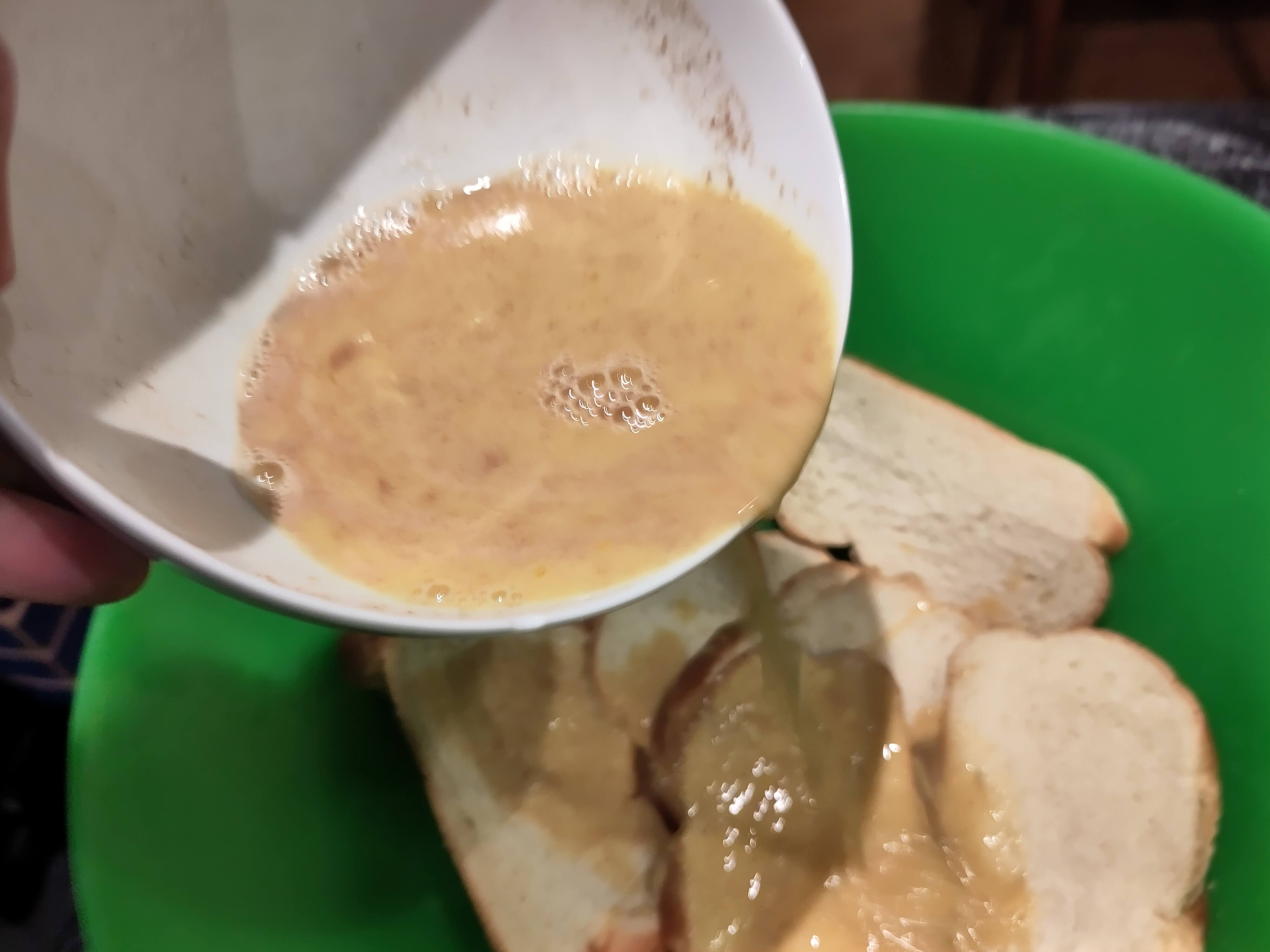
In a large pot, cook the onion, garlic, lardons, & herbs in a bit of cooking oil until the onion bits are translucent. Set this aside to cool a bit while you slice the stale bread very thin and put the slices in a large mixing bowl. Mix together the eggs, milk or beer, and nutmeg, then pour this mixture over the bread. Then add the earlier cooked ingredients (including the oil).

Knead the mixture thoroughly with your hands until there are no dry bread chunks left, and then form the mixture into 6-8 balls.

In the same pot as before, cook the second set of ingredients as follows:

Add some more cooking oil and cook the onion, hot pepper, and herbs until the onion bits are translucent. Then add the vegetables, mushrooms, and broth, starting with whichever vegetables need to be cooked the longest. Bring it to a boil, then add the crème fraîche and bring it to a boil again, then reduce the heat to a simmer.

Place the dumplings on top of the vegetable stew and cover the pot. Simmer covered for 20 minutes.

Serve and enjoy!

This recipe is a combination of two different recipes I found in some local cookbooks -- with my own modifications based on the experience of making it all the time. The recipes are "Semmelknödel auf Rahm-Kürbis", p.25 of Martina Kittler's "Kürbis: Das Best vom Herbst" (GU Küchenratgeber, 2013), and "Brot-Knödel auf Rahm-Gemüse", p. 68 of "Resten Los Geniessen" (Betty Bossi, 2018).

I love making this recipe because I love to mix-and-match flavors! And I love to try out different seasonal vegetables! You can use essentially any vegetable that you might normally use in a soup or stir-fry.

Naturally you can use "Kürbis" (pumpkin/squash), broccoli, spinach, zucchini (though that one gets a little mushy), bok choi, green beans, snap peas, etc., etc. In this instance I used carrots, brussel sprouts, and kale.

You can even use protein chunks such as meat or tempeh in place of part of the vegetables.

Ideally, you can make this recipe with just ingredients that you already have in your kitchen -- so it's cozy comfort food for a lazy day when you weren't planning to go out. And since you can substitute your own favorite ingredients at every step, your version will taste better to you than mine would!

Unless you specifically dislike mushrooms, I would recommend not skipping the mushrooms as part of your 500 grams of vegetables and mushrooms. They really affect the flavor.

This time there were some fresh local mushrooms in the shop, so I bought them specifically for this recipe.

However, even when I use fresh mushrooms (and especially when I don't have any on hand), I generally add some dried mushrooms as well. They impact the flavor even more than the fresh ones do, so it's a good idea to keep some dried mushrooms in your cupboard for such occasions.

If you're using dried mushrooms, start by re-hydrating them since it takes about 20 minutes. They'll be ready by the time you need them.

In this picture you can also see the fresh herbs I picked from my balcony garden (thyme, rosemary, and sage). This January heat wave we're having is kinda scary, but I guess I have fresh herbs year-round, so yay...?

You can use your own favorite herbs from your own garden -- or maybe you or someone else in your household bought some fresh herbs for a recipe and didn't use them up -- feel free to try them out in this!

If you don't have any fresh herbs, naturally you can use dried herbs instead.

I normally divide the herbs so that I'm using some for the knödel and then different ones for the stew so that the components will have different flavors.

When sautéing the onions for the dumplings, I generally use the same pan I'm planning to cook the whole lot in later. Naturally you can use a different pan if you like, but then you have to wash two pans.

I had thought that pine nuts might make a good vegetarian alternative to using lardons in the dumplings, but they didn't really work because the flavor was too subtle.

So in this picture I'm using vegan faux-lardons from Outlawz Food. These worked really well and were quite delicious, so I'm definitely using them again.

For the bread, one recipe recommends Ciabatta (which works well), and the other lists various breads. I usually use butterzopf (which is like brioche) because my kids like it for sandwiches, and (if not eaten) it gets hard/stale by the next day.

More or less any bread will work as long as it's at least a bit stale/hard so that the liquid of the recipe can penetrate it. Both recipes say to use bread from the previous day, but I've found that bread that's up to 4 days old works just fine. Just keep in mind that the harder it is, the smaller the pieces you need to cut it into (and obviously don't use bread that's moldy, etc.).

For the liquid, both recipes say to use milk (one says milk or water), but I like to use beer instead.

This is because one time I started making this recipe and realized that we didn't have any milk (since we don't use milk that often), so I had to find a substitute. I'd heard that beer can sometimes be used as a substitute for milk in recipes (and we definitely have that), so I decided to try it out -- and it works great!

An extra advantage of using beer is that it's not sold in 1 dl portions (that's just a 10th of a liter), so you can open a bottle, set aside 1 dl of beer, and drink the rest while making this recipe!

Naturally the eggs can also be replaced with vegan egg-substitutes.
Forming the dumplings is quite simple. Just squeeze everything together with your hands until everything is mixed and there are no lumps of dry bread. Then form the balls with your hands.

I usually make six of them to make it easy to divide this into three portions, but you can also make eight for four portions.

Then set this aside and start on the vegetables.


I usually add a hot pepper here because I like the flavor combination of spicy and creamy. Neither recipe includes this (not even as a suggestion), so feel free to leave it out if you don't like spicy food.

In this case, I had preserved some hot chilis from my balcony garden in olive oil, so I used some of that for both the chili and part of the cooking oil.

(You can see my little jar of hot chilis on the right-had side of the picture of bowls of ingredients above.)

The biggest difference between my recipe and the ones in the books is the amount of broth. One calls for adding 1 dl of broth, and the other none at all. So why do I recommend half a liter of broth?

Since a bouillon cube makes half a liter of broth, I initially used to make the 5 dl and then only use 1 dl. But I found that -- depending on the vegetables you're using -- it's easier to cook them down without burning them (and simmer 20 minutes!) if you use more liquid. And since I already had more broth right there, I started using more and more of it until I ended up using all of it every time.

As you might guess, this changes the character of the recipe entirely. Both of the initial recipes are for dumplings that can be served on a plate with a vegetable cream sauce over them. My version is more of a soup or stew (hence the title) that's served in a bowl.

If you'd prefer a creamy sauce rather than a creamy stew, you can easily achieve this by using 1 dl of broth rather than 5. But, personally, I love soups and stews! So that's how I make this recipe.

If you make it as a stew, the cream actually becomes optional. If you prefer a transparent brothy soup rather than a creamy soup, you can leave out the cream entirely.

If you don't have any crème fraîche, you can substitute heavy cream. I've done this, and it works fine.

If you'd like to substitute lower-fat dairy products (like yoghurt or sour cream), the one thing to be aware of is that they can curdle when cooking them. So if you're using a substitute here, just be sure to pick something that is made to be cooked.

Then -- after a quick 20-minute simmer in their own soup or sauce -- you have delicious knödels! Made with your own favorite ingredients!

Enjoy!


Sunday, July 24, 2022

A Mathematically-Optimised Party!

When throwing a great party, it's important to provide goodies that all of the guests will enjoy. If you know all of the guests and their tastes, then it's pretty easy to tailor your offerings accordingly. But throwing a larger party presents a fun challenge in terms of making sure there's at least a little something good for everyone.

Since I'm trained as a mathematician and tend to throw parties for mathematicians, naturally I can't help but approach this challenge in a mathematical way.

Specifically, I set out to throw a party in which half of the finger-foods have dairy and half don't, half of the finger-foods have meat and half don't, and half of the finger-foods have gluten and half don't. Thus I prepared 2 x 2 x 2 = 8 different recipes!

Starting from the recipe with none of the above, let's review all of the options I prepared:

Tortilla Chips and Guacamole

❌ Gluten, ❌ Dairy, ❌ Meat

This is a perennial favorite and quite easy to make.

Sometimes I make guacamole from scratch, but for this party -- since I was preparing so many items -- I didn't want to deal with the additional cleanup of the food processor, so I just bought some guacamole and mixed it with salsa, plus some hot peppers from the garden for one of the portions of dip.


Bruschetta Toasts with Balsamic Vinegar Pearls

 ✅ Gluten, ❌ Dairy, ❌ Meat

Again I went the lazy route and bought the bruschetta in a jar. Since it can be prepared in advance, I could have prepared it myself -- and maybe I should have since I ended up not having quite as much as I wanted. The toasts should generally have a bit more bruschetta on them than you see in this picture.

All you need is some leftover bread (baguette works especially well). Wait until your guests arrive before toasting it because the toasts with bruschetta on them can get soggy fairly quickly -- but they're quite delicious right when they're prepared.

(Toast the bread slices by themselves and add the bruschetta and garnish after toasting.)

I've found that balsamic vinegar pearls are a nice garnish for bruschetta toast. They're a good compliment in terms of flavor as well as color and texture.

My apologies in advance to all of my vegan friends for the rest of this article... you can stop reading now. 😀

Caprese Bites

❌ Gluten, ✅ Dairy, ❌ Meat

This is one of those finger-foods that I would call "canonical" -- it's such a standard, obvious, perfect combination that it's generally pictured on the package of the mozzarella balls. (Indeed, I'm not sure that mozzarella balls the size of cherry tomatoes exist for any other purpose.)

Caprese bites are delicious, easy-to-make, and can be made early in the day (so they're not taking up that precious hour just before the guests arrive).

Just get a bunch of cherry tomatoes and an equal amount of mozzarella balls. Wash the cherry tomatoes and slice them all in half and add salt and olive oil. Then slice all of the mozzarella balls in half, and pair each one with a half-tomato -- placing a fresh basil leaf in between -- and attach them with a toothpick.

Sashimi Crunch

❌ Gluten, ❌ Dairy, ✅ Meat

This is a recipe I invented myself.

Basically, I like sushi, I like sushi flavors, and I like making sushi for dinner parties. The problem is that getting the rice just right is a time-critical operation, and I don't want to deal with that while trying to coordinate the scheduling of all of the other food preparation.

My solution? Skip the rice.

So it's not actually "sushi", but the preparation of this dish is very similar to preparing maki.

I happen to have a number of these little ceramic/earthenware bowls (?) that some French cheeses are sold in, and I figured I could use them for finger-foods.

The ingredients you need to make 8 of these are the following:

1 long cucumber

~ 120 grams smoked salmon, sliced thin

Sushi nori sheets (about 2 or 3)

Soy sauce

Wasabi

It is very important that the cucumber remain as fresh and crisp as possible, so this recipe should be one of the last things you prepare before the guests arrive.

Peel the cucumber and cut it in half, and cut each half into four sticks:

Then carefully divide the smoked salmon into either 16 or 24 thin strips:

I sliced it into 24 strips in this case because the slices of salmon I bought were fairly small, so I couldn't make 16 long ones, just 24 short ones.

Note that it's OK to kind of piece together some partial pieces -- they don't really need to be perfect.

Then, if you're a mathematician following along, you can probably guess that we'll be adding 3 pieces of salmon to each of the 8 cucumber sticks.

Prepare a bowl of water so that you can get the nori wet with your fingers to make it sticky (as you would do for making maki).

Slice three strips of nori and place them (shiny side down) on the first three strips of salmon in such a way that the bottom of each nori strip aligns with the bottom of each salmon strip, and the top extends beyond the salmon:

Then get the nori a bit wet with your fingers and place a stick of cucumber across the top ends of the three strips and roll the three strips of nori (along with the salmon) onto the cucumber.

Note that it is very important for the nori to be sliced like this so that each cucumber stick has 2 or 3 separate bands of nori/salmon on it. This is because it is impossible to bite through the nori. The objective is to allow the guest to dip the cucumber in the soy sauce & wasabi and eat it in multiple bites. The bites of nori need to be separate for this to work.

Once you have prepared all 8 cucumber sticks in the same way, you can put them in the fridge for a little while -- just be sure to separate them from each other using cellophane or equivalent.

I generally mix some soy sauce with wasabi in advance of the party so that it is very easy to assemble these appetizers just before the first guests arrive. Just pour a bit of soy sauce & wasabi in each bowl and place the cucumber stick across the small bowl as pictured above.

These have gotten rave reviews, which makes up for the fact that they're a little more labor intensive that some of the other items in this collection.

Of course if you would like to spend more effort on a different finger-food and you'd like something super simple for the "meat-but-no-dairy-or-gluten" category, the "canonical" choice is, naturally, prosciutto e melone:

I did not actually make this for the same party as all of the other recipes, and I assume I don't need to explain how it's done since it's pretty self-explanatory. 


Filled Mini-Pastetlis

✅ Gluten, ✅ Dairy, ❌ Meat

These little pastetlis can be purchased pre-made. Then, when the guests arrive, you just need to warm them briefly in the oven and fill them.

There are tons of different options for fillings. Typically one would use a soft cheese as a base (gorgonzola, mascarpone, or ricotta) and maybe add another food to stuff them with such as a half walnut (the suggestion on the package), or something like I've done here, stuffing some with artichoke hearts and others with stuffed olives.

I feel like this was probably the least-successful item I made for this party because I didn't really test and come up with a good flavor combination in advance. So I used mascarpone mixed with garden herbs (especially sage) and then the stuffing items you see above. This flavor combination did not work.

First of all, I found ricotta was better than mascarpone with the olives & artichokes, and the sage was just really wrong, so it's better to leave it out entirely. But when using ricotta alone with the olives and artichokes, they result is too bland. Maybe mixing the ricotta with a bit of tomato paste and chopped basil would be better...? Anyway there are a lot of possibilities, so this dish is still a work-in-progress.

Salami & Sbrinz

❌ Gluten, ✅ Dairy, ✅ Meat

This is another "canonical" one: It's really easy to make because the flavors of a couple of simple ingredients complement each other so perfectly.

Basically just get a whole Salami Milano and cut it into cubes, and get a block of Sbrinz and cut it into cubes of about the same size as the salami cubes. Then stick them together, two to a toothpick.

I always put the salami cube on top because Sbrinz is a hard, crumbly cheese, which will crack in half if you try to stick a toothpick all the way through it.

You can potentially use a different cheese -- indeed, a less-crumbly one might be easier to work with -- but I think for the flavor combination you can't beat Sbrinz.

Tortilla roll-ups

✅ Gluten, ❌ Dairy, ✅ Meat

These are quite easy to make, they can be made a bit in advance (earlier in the day), and they are surprisingly tasty.

Basically, I just take some soft, wheat tortillas and spread each one with some sauce. I found that (Thomy) Truffle dip works really well for this recipe, but there are lots of other possible sauces or condiments that would work as well.

Then, on each one, I put two slices of prosciutto across the middle and place some fresh lettuce.

Ideally the lettuce should be crispy and crinkly. For this party, I used lettuce that I grew in my garden.

After placing the lettuce, fold one flap over the lettuce, but don't align the two edges (otherwise the inner lip will extend beyond the outer one when you roll it).

Then roll it into a somewhat-tight roll starting from the fold. Once it is rolled, insert 4 toothpicks to hold it closed, and slice it into 4 sections, as pictured above.

For presentation, naturally, it's nicest to stand up the segments on the plate:


For the final category -- the one that combines all three restricted items -- I used a very unusual and imaginative recipe that I got from the Betty Bossi "Apéro & Fingerfood" cookbook, p. 20:

Cervelat-Tortellini-Spiessli

✅ Gluten, ✅ Dairy, ✅ Meat


This picture is from the preparation stage. The picture after it's cooked is below.

Here's how you make it:

Get a pack of 2 cervelats. If you do not have cervelat in your country, you might be able to substitute bratwurst or some other sausage, but I doubt it will be as good.

Peel the casing off the cervelats. In the picture in the cookbook they actually look like they're not peeled (though the instructions say to do it), but if you don't peel them, this snack is very difficult to eat (I made this mistake the first time I made this).

Take a package of fresh tortellini. In this party I used the recipe's recommended tortellini (filled with spinach and ricotta) -- which worked very well in terms of flavor combination. The cookbook seems to imply that other fresh pasta could be used in place of tortellini, but I tried it with ravioli, and the edges burned. Use tortellini.

Take 100 grams of Gruyère or Emmentaler and cut it into cubes, and slice the cervelats into rounds. The objective is to have essentially equal numbers of cheese cubes, tortellinis, and cervelat slices so that they can be stacked and attached (with a toothpick) as shown in the above image.

These can be prepared early in the day and stored in the fridge, and then they can be cooked after the guests arrive. Add some paprika and olive oil to each one and cook them for about 10 minutes in a 180C oven.

I unfortunately didn't get a good picture of these after they were cooked -- I guess I was busy throwing a party or something -- so my one photo kind of looks like those "nailed it" images of attempts to make beautiful foods found on Instagram. 😂😂😂

But another problem was that I used a somewhat larger/cheaper bag of tortellini, and most of the tortellini were kind of misshapen and didn't sit nicely on the cervelat slices.

The next time I make this recipe, I'll make sure to get the highest-quality fresh tortellini.

And I will definitely make it again, because this always gets lots of compliments. It's very rich, though, so be sure to serve lighter fare alongside it, as I've done in this mathematically-optimised collection!

And I'll close with a couple of pictures of my garden (before I harvested the lettuce and basil and sage and mint (for the Hugos)), plus a photo of preparing for the party:


As you might have guessed, the party was a big success, and we'll be sure to be throwing more soon!!


Wednesday, December 25, 2019

Goulash Soup


  • 1.2 liters broth (in a soup pot that holds two liters+)
  • 0.2 liters red wine
  • 600 grams beef or meat substitute (such as Dinki-Gulasch Goulash, 3 packets), in small cubes (1-2 cm diameter)
  • 1 packet (50 grams) "dodatak jelima sa povrcem za Goveđi Gulaš" Vegetable seasoning mixture for beef paprikash
  • 1 large onion sautéd in olive oil
  • 300 grams potatoes, peeled and cubed in 1 cm cubes
  • 1 small knollensellerie (celery root/knob, 200-300 grams) or similar root vegetables, peeled and cubed in 1 cm cubes
  • 2 carrots or similar root vegetables, peeled and chopped
  • 250 grams sweet peppers, red & other colors, chopped in small pieces
  • 1 jar (approximately 300 grams) "Ajvar" (spicy Serbian red pepper sauce)
  • salt, pepper, and paprika powder to taste


    Combine in the logical way:
    1. Boil the broth.
    2. Add the veggies in the order of which ones need to cook longest.
    3. Add everything else (including the olive oil the onions are sautéd in).
    4. Simmer for 1 hour
    5. Add salt, pepper, and paprika to taste.

    Sunday, September 20, 2015

    Autumn Pumpkin Quinoa Salad!

    This is probably the best recipe I have invented so far!


    If you love it when the Autumn foods (pumpkins, squashes, chestnuts, unusual mushrooms, etc.) start arriving in the supermarket -- and/or if you look forward to Autumn for the pumpkin-spice lattes -- this is going to be your new favorite Fall salad!

    It would make a good side-dish if you're hosting a Thanksgiving dinner in which some guests are vegetarian or vegan. However, if you're planning to serve this for Thanksgiving, I must apologize in advance for giving all the measurements in metric -- that's just how we roll here in Europe.

    Ingredients:


    3/4 Liter (750 mL) vegetable broth
    300 grams dry quinoa
    250 grams diced pumpkin or squash
    1 apple (diced)
    2 onions (diced)
    100 grams mushrooms (chopped)
    50 grams pumpkin seeds
    4 teaspoons nutmeg
    2 teaspoons ground cloves
    2 teaspoons ginger
    2 teaspoons cinnamon
    salt to taste
    chopped parsley
    olive oil

    First, prepare all the ingredients, since that's the part that takes the longest:


    Put the quinoa in the broth and bring it to a boil. Then add the pumpkin/squash, apple, spices, and salt and cook on low heat, uncovered, until the liquid has been absorbed by the quinoa (about 15 minutes). While the broth is simmering, sauté the onions, mushrooms, and pumpkin seeds in olive oil. Once both parts are done, mix them together and add the parsley (and maybe add some more olive oil).

    This can be served warm or chilled.

    Here are a few notes about the recipe:

    • If they don't sell pumpkin seeds for cooking in your area, you can maybe substitute some type of nuts. But don't just use the seeds from the fresh pumpkin unless you know it's a type that has good seeds (and you know how to prepare them).
    • Pretty much any type of pumpkin or squash can potentially work in this recipe except spaghetti squash or those jack-o-lantern pumpkins (that aren't really for eating), so try something local and seasonal!
    • The pumpkin in the first ingredient picture above weighed more than a kilogram, so it's actually way more pumpkin than you need for this recipe. But you might as well skin and dice the whole thing at once, and set aside the leftover part to make pumpkin pie or soup later.
    • I like to use umami in place of salt in most recipes. I used both when I prepared this salad. 

    Enjoy!!

    Saturday, June 07, 2014

    Sun-dried tomato Mascarpone spread!

    Here's another little recipe I invented!

    I like throwing parties, so I'm always on the lookout for new finger-food ideas.  I would blog more of my creations, but I'm not that big on photography.

    Anyway, I love sun-dried tomatoes, but they can be a challenge to work with because they have such a strong, rich flavor.  In the past, I've tried just spreading Mascarpone cheese on them (as a fresh and creamy complement to the sharp and salty tomatoes).  The flavors complement each other, but it was just too strong and rich.  So, I decided to chop the tomatoes and mix them into the mascarpone to make a spread.

    Here's what you need:

    • (approximately) 250 grams of Mascarpone cheese.  Take it out of the fridge well in advance so that it will be soft when mixing it with the other ingredients.  It will also stick to cucumbers better soft (if you decide to spread it on cucumber slices).
    • (approximately) 50-75 grams of sun-dried tomatoes, chopped small.  I find that it's simplest to chop them all lengthwise first and then chop them crosswise in bunches.
    • 2 to 3 Tablespoons of pine nuts.
    • Oregano to taste, either fresh chopped or dried.  As you can see from the picture, I used fresh oregano sprigs from my garden as a garnish.
    • Grated lemon rind.  Basically take one small lemon and fine-grate all of the yellow surface of it off to use in this recipe.
    Mix all of the ingredients thoroughly, and it's ready to spread!

    This can of course be spread on bread or crackers, but it is especially good on cucumber slices because the light, fresh, crisp cucumber flavor and texture complement the sharp, rich, creamy flavor of the spread.  The biggest challenge with cucumbers is that spreads don't stick very well, but (as mentioned above) it sticks a little better if the spread is at room temperature.  A friend recommended placing the cucumber slices on paper towels (to eliminate some of the water), but that may reduce the crispiness.

    I've tested this recipe at a party I threw for my colleagues and also at a party I threw for the post-Mormons of Switzerland, and it has been a hit each time.  I hope you'll like it!

    Saturday, April 12, 2014

    Fun with quinoa!!

    Like the food-storage mom, I'm interested in cooking with dried beans and grains because it's healthy and economical.  I don't do it as often as I'd like (mostly because the people in my family don't like anything more complicated than plain pasta), but every now and then I like to try it.

    As soon as I read that quinoa has a high protein content and can be grown in arid land, I immediately wanted to try to add more quinoa to my diet.  I'm not actually vegetarian, but I think that it's important to try to eat as little meat as possible, for environmental reasons.  It appears that quinoa is a pretty Earth-friendly food to switch to!

    Pretty much all of the recipes I've seen for quinoa are variants of a tabbouleh-style salad, so I went out and bought a quinoa cookbook, in hopes of finding a bit more variety.  After reading through it, however, I was no more inspired than before -- and I kind of came to the conclusion that maybe making it into a salad is the classic quinoa dish for a reason.

    In my version, I cooked the quinoa according to the standard instructions on the package, and I also included some kidney beans and chick-peas that I had prepared (soaked overnight and then cooked at a low boil for an hour, then strained).

    After putting these three ingredients together, you can kind of just throw in whatever other ingredients you like in this sort of salad.  In my case I added a packet of feta cheese (cubed), 1/2 cucumber (diced), chopped pitted olives, and some fresh herbs (parsley, dill, mint).  I also sautéd some chopped onion with pine nuts and pumpkin seeds, and added them as well.  Then I added oil, vinegar, salt, and pepper to taste.

    I found that quinoa also works as an additional ingredient in my usual sort-of-minestrone soup recipe.  That recipe is one to remember if you're actually living off your food storage because it doesn't require any fresh ingredients (though I usually use fresh green onions).

    In addition to the beans and chick-peas (soaked overnight), put about 100 grams of quinoa in 2 liters of broth, and cook them for about an hour with some peeled, chopped tomatoes (I used canned), and some chopped onions and herbs.

    I would like to maybe try some more adventurous recipes with dried beans and/or quinoa, but these basic recipes are some good basics to start with.