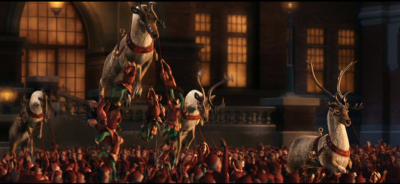
lead elder: Harmless? It is this kind of backsliding that has brought the scarcity upon us!
a foreign penguin: Excuse me smiley, could you speak plain penguin please?
Mumble: He thinks the food shortage has something to do with me.
lead elder: Do you not understand that we can only survive here when we are in harmony? And when you and your foreign friends lead us into your easy ways you offend the Great Guin -- you invite Him to withhold His bounty!
an elder: He rules the seasons.
an elder: He giveth and He can taketh away.
Mumble: Wait a minute -- happy feet can't cause a famine.
an elder: If that kind of pagan display didn't cause it, then what did?
Mumble: I think it comes from outside -- from way beyond the ice. There are things out there we don't understand.
foreign penguins: Mysteries! Mind-boggling mysteries! Mystic beings!
Mumble: Yeah, aliens. I've heard they're smart.
an elder: He's insane!
Mumble: No, they might be smarter than all of us -- who knows?
 an elder:
 He drove the fish away, and now he's ranting this rubbish.
a foreign penguin: Let me tell something to you.
an elder: Don't touch me, you filthy varmint! [smacks him]
Mumble: Watch it!
lead elder: So it follows: dissent leads to division and division leads us to doom! You Mumble "Happy Feet" must go.
Mom: Don't you take one step, Sweetheart. You have as much right to be here as any of these daffy old fools.
all: [shocked gasps]
Dad: Norma Jean, I'll deal with this.
Mumble: Pa?
Dad: Mumble, you must renounce your so-called friends, your peculiar thoughts, and your strange ways. If we are devout and sincere in our praise, the fish will return.
Mumble: But Pa...
Dad: Listen boy, I was a backslider myself. I was careless, and now we're paying the price.
Mom: What's this got to do with Mumble?
Dad: That's why he is the way he is.
Mom: There's nothing wrong with him!
Dad: Face it, Norma Jean! Our son's all messed-up!
Mom: He is not messed-up, you hear me?
Dad: Believe me, I know he is!
Mom: How can you say that?
Dad: Because when he was just an egg, I dropped him.
all: [shocked gasps]
Mom: Mumble! Oh, my poor little Mumble!
Mumble: Ma, I'm perfectly fine.
Dad: No you're not, boy. For all our sakes you must stop this freakiness with the feet.
lead elder: Your father speaks wisely. Heed his suffering heart and repent.
Mumble: But it just doesn't make any sense!
lead elder: Then your arrogance leaves us no choice!
Dad: No, wait! [to Mumble] Son, you can do this. It ain't so hard.
Mumble: Don't ask me to change, Pa. Because I can't.
Why was I surprised to see this scene in a big-budget animated feature for kids? The answer leads me to another favorite film at our house: Disney/Pixar's
Cars:
Cars and
Happy Feet are both charming films with a lot to recommend them -- not just in terms of stunning visuals (both are excellent on that count), but also in terms of storytelling. Regardless of what the Disney-phobes say, sometimes kids' blockbusters aren't too bad. And it matters for my sake as well as my kids' sake since any film they love I end up having to watch a million times myself.
For the moment I'm not doing an overall movie review, though, I'd just like to talk about each film's message. (For this topic I'm only covering films that are worth analyzing, which is why I'm skipping
Thomas and the Magic Railroad, a film whose story and dialog are so formulaic that I swear the screenplay was written by a computerized script-generating program and whose moral is "if you need to cut corners on your medium-budget film, skimping on writers isn't the place to do it...")
Cars is very much a sports film, so its primary moral is standard sports film fare: learning that there are more important things than winning. The secondary moral deals with the charming little town of Radiator Springs and how it became run-down and forgotten.
Radiator Springs was a jewel strung along the necklace of Route 66: a lively and bustling town back when people used to travel a whole different way ("to have a great time, not to make great time"). It deteriorated to the point of being nearly deserted after it was bypassed by the interstate highway that cut through the land instead of following its contours.

The thing that impressed me most about the heart-string-tugging emotional center of the piece (the song
Our Town), was the way they took a political issue (the deterioration of small-town America) and presented it in such a way that it would appeal to both liberals and conservatives. I don't think anyone out there is seriously arguing that we should eliminate the interstate highway system. So presenting the interstate as the culprit is a safe choice: Republicans see the characters pining for the nineteen-fifties -- back when everything was simple and innocent -- and Democrats can read "the interstate" as a metaphor for "Wall-Mart."
Naturally I saw
Cars as another example of the law that no big-budget kids' film can be made without passing the generic-moral no-parent-offended committee. That's why I was so surprised by
Happy Feet. Skeptical/secular parents: this film is for you.
Here's the story in a nutshell:
Mumble is different from the other penguins from the moment he hatches from the egg. Emperor penguins are supposed to sing and not dance, yet Mumble is the opposite. There's a shortage of fish and none of the penguins know why. The religious leaders make up an explanation and they're wrong. Mumble doesn't accept their explanation and instead is curious and starts piecing together bits of evidence to find that the fish shortage is caused by "aliens" (humans overfishing). His travels lead him to a preacher/guru penguin who has apparently had some contact with the "aliens" (evidenced by a man-made object attached to him), but he doesn't want to help Mumble at first because he's too wrapped up in the wealth and status he gets from pretending that he has the power to contact mystic beings. Eventually he comes around and sets off with Mumble and friends to find the aliens. The happy ending is that Mumble finds the aliens and makes contact with them through dance, persuading them of the importance of protecting the area around Antarctica from over-fishing.

On the surface this looks like a retelling of
Rudolph the Red-Nosed Reindeer: the misfit is rejected until his unusual trait saves the day. But
Happy Feet also has a strong theme of reason and evidence trumping the closed-minded shackles of religion. The one twist that may superficially look like a jab at skeptics is the fact that tales of "alien abduction" turn out to be true. The difference is that in our human universe the tales one hears of alien abductions don't have evidence to back them up. This film correctly illustrates the fact that the skeptic will take an outlandish tale seriously as soon as the evidence warrants it.
The scene I quoted above is probably the most daring part of the film. The religious elders claim that God's wrath for Mumble's deviance is the cause of an unrelated disaster. Mumble's father blames himself for Mumble's deviance, and tries to persuade him to repent and try to be like everyone else. Even though Mumble (like all of the characters in the film) is clearly straight (and he has a rather generic straight love story in the film to back it up), I can't avoid seeing Mumble's situation as a transparent metaphor for being gay; illustrating how religion can inspire injustice.
(Actually, I wouldn't be surprised at all if the writers of this film were gay men. There's the mom and the love-interest who are framed entirely by their relation to Mumble, and aside from that it's male-male buddies all the way...)
Mumble's situation could also be taken as a metaphor for being an atheist since everyone knows that atheist is the new gay. ;^)
The point that stands out, however, is that -- unlike practically every children's story I've seen in my entire life --
Happy Feet presents the conflict of reason versus faith and doesn't give a single nod towards faith being the better choice.
The ending message of environmentalism and cross-cultural understanding is the icing on the cake of this bold film with courageously modern morals to guide our kids as they prepare to take the reins of our globally-interdependent world.


 For years I'd been looking for a quick, readable synopsis of what is currently known about the origin of life. I'll bet a number of you out there are looking for the same thing. It's an area of active research, so whatever you learned about it in your Biology class (if anything) is probably not current anymore. Well, Nick Lane gives a straight-forward account of it in Life Ascending
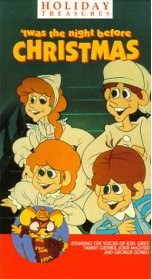 I don't know if all of you have seen that cartoon with the mice as many million times as I have, so since it's less famous, I'll give you a quick run-down: The nerdy poindexter too-smart-for-his-own-britches brainiac mouse writes a letter to the editor of the local paper explaining that Santa Claus doesn't exist, and Santa Claus takes offense and decides he won't be giving any presents to anyone in the whole town. (Nice, huh?) So the others convince poindexter to believe in Santa and to fix the town's special clock that was built to placate Santa with Christmas music.