Showing posts with label skepticism. Show all posts

Sunday, August 31, 2014

Fun at Camp Quest Switzerland!!

So, how was Camp Quest? you ask.

It was a fantastic experience, and I'm really glad my kids and I participated!

If you haven't heard of it, Camp Quest is an organization of secular summer camps -- mostly in the US, but also in the UK and (luckily for me!) here in Switzerland. But before I get into the pictures and what we did there, I would like to explain a bit about why I wanted to participate in this.

As a kid, I always liked going to camp. It was great to be out in nature, doing things that were completely different from my usual life. I even liked sharing tents or cabins with a bunch of other girls (with midnight activities like ghost stories and such) despite the fact that I always had difficulty making friends and being accepted as part of the group with other girls. Whether it was with the Girl Scouts, a school camp, or (most frequently) a Mormon church camp, it was a fun adventure!

Now that I no longer believe nor practice Mormonism, I don't have the built-in community that comes with it. The opportunity of passing camp fun along to the next generation as an adult volunteer is one of the things I gave up when I left the church. Probably many of you are thinking, "I hated camp! Not having to got to camp is one of the perks of being an atheist or a none -- not a drawback!" But, as I've said many times, religion and religious organizations fill many roles in people's lives, and it's totally normal that the parts one person loved may be exactly the parts someone else hated, and vice-versa. So if you hated camp, this post isn't about telling you you're wrong, it's about the variety of different experiences we humans enjoy.

In my case, one of the parts of camp that I hated was the pressure to feel "spiritual" emotions and to sit around and express them in some sort of testimony format. As a Mormon kid, I spent a lot of time trying to psyche myself into liking testimony meetings (and tried desperately to gain a testimony -- this stuff is really important for Mormons), but I was really fighting my built-in reaction that this stuff is really, really creepy and weird. I know a lot of people sincerely like that sort of thing (including people who don't believe in the supernatural), but for me personally, a big perk of Camp Quest was no testimony meeting. Nothing even remotely resembling it.

A lot of people in the non-believer community feel that we shouldn't be doing things to ape religion (like make our own summer camps). And if Camp Quest really isn't about trying to indoctrinate kids to being atheists (i.e. some sort of equal-and-opposite of Jesus Camp), then why bother having a specifically "secular" camp, as opposed to just sending your kids to some sort of generic science camp or something...?

In response, I would say that religion didn't invent summer camp. Summer camp does not inherently have anything to do with ideology, but it's normal to have a variety of camps focused on different themes. Camp Quest Switzerland in 2014 included lots of fun workshops in science, mathematics, and skepticism, but it was not about sitting around telling the kids what to believe or patting ourselves on the back for our shared ideology. In fact, there was another mom who had come along to volunteer as well who is a theist. She doesn't participate in organized religion (she's from a Catholic background, and her husband was from a Muslim background), but she's raising her kids to believe in God. And there's no reason for that to be a problem in this environment.

But why not just a generic science or other camp? Why something that has any ideological connection?

Well, I actually want to be part of a community. I volunteer at my kids' school, I participate in neighborhood events, and I think there's something to be said for participating in local groups with people you share ideas and interests with as well. (My husband and I are planning to join the Zürich Freethinkers as soon as I figure out how to work the website.) For the past few years, we've been sending the kids to Vacances Edcuatives in France during the February vacations (mostly because we don't want our kids to be the only ones in their class who don't ski, yet we don't want to bother to go skiing ourselves), and that has been a good experience -- but it's not the same as participating in a camp that is connected with a real community that you can be a part of.

Now, after all that intro, here's what we did!!


First of all, the location was gorgeous, up in the mountains!

Normally I like to enjoy Switzerland's beautiful mountains from somewhere down on the ground looking up at them. Actually going up into the mountains, riding along on those tiny, winding roads where one slip of the driver's hand could send you falling to your doom -- well, it's the sort of trip that I love in retrospect, after I'm back on the ground alive, like now. And this trip was no exception. 

But seriously, it was very cool to spend a week in a tiny village on the side of a mountain with a beautiful view of the valley and the mountains and mountain villages on the other side. And it was awesome to celebrate the Swiss national holiday (August first) in real Swiss style!


For much of the week, the kids participated in activities offered by the local tourism industry: workshops on making bread and cheese, a hike to a cabin where a local storyteller told us some folk tales in dialect (which I didn't understand at all, BTW, but it was interesting), and a nature hike/treasure hunt.

Plus the adult leaders of Camp Quest offered a series of workshops at the chalet where we were staying. In science and nature, we had an activity learning about the local plants, plus some physics experiments such as making a pickle glow by running electricity through it, and a hands-on biology lab dissecting the heart and lungs of a pig.


There was also an improv theater workshop that my son Léo really enjoyed, and two skepticism-themed workshops: one on illusions and one on homeopathy where the kids got to make their own homeopathic remedies. Note that the kids weren't fed any conclusions about homeopathy -- they simply got to see what it really is, and they were left to draw their own conclusions.

My workshop was a mathematics workshop on tiling the plane. For it, I made about a million Penrose Tiles for the kids to play with:


The Penrose Tiles were fun, but even after having done a few recreational math workshops at my kids' school and now this, I still think my presentation style need work. But it gets a bit better with each experience!

All in all a fun experience -- I hope to send my kids again next year!

Thursday, October 16, 2008

Nacho Nanny Rolls!!!

I was just playing with this silly anagram server, and that was the best one it came up with for my blog-name "Carol Lynn Hanson" (which is not exactly the same as my real name, as I explained here).

The anagram site claims "All the life's wisdom can be found in anagrams. Anagrams never lie," but I'm a little skeptical. I think they're trying to sell me something...

Of course it also came up with "Cannons All Horny."

Not too bad. It's probably wise, profound, and true if only I can figure out the correct interpretation. ;^)

Tuesday, July 24, 2007

Morals for children in Cars and Happy Feet

lead elder: Harmless? It is this kind of backsliding that has brought the scarcity upon us!
a foreign penguin: Excuse me smiley, could you speak plain penguin please?
Mumble: He thinks the food shortage has something to do with me.
lead elder: Do you not understand that we can only survive here when we are in harmony? And when you and your foreign friends lead us into your easy ways you offend the Great Guin -- you invite Him to withhold His bounty!
an elder: He rules the seasons.
an elder: He giveth and He can taketh away.
Mumble: Wait a minute -- happy feet can't cause a famine.
an elder: If that kind of pagan display didn't cause it, then what did?
Mumble: I think it comes from outside -- from way beyond the ice. There are things out there we don't understand.
foreign penguins: Mysteries! Mind-boggling mysteries! Mystic beings!
Mumble: Yeah, aliens. I've heard they're smart.
an elder: He's insane!
Mumble: No, they might be smarter than all of us -- who knows?

an elder: He drove the fish away, and now he's ranting this rubbish.
a foreign penguin: Let me tell something to you.
an elder: Don't touch me, you filthy varmint! [smacks him]
Mumble: Watch it!
lead elder: So it follows: dissent leads to division and division leads us to doom! You Mumble "Happy Feet" must go.
Mom: Don't you take one step, Sweetheart. You have as much right to be here as any of these daffy old fools.
all: [shocked gasps]
Dad: Norma Jean, I'll deal with this.
Mumble: Pa?
Dad: Mumble, you must renounce your so-called friends, your peculiar thoughts, and your strange ways. If we are devout and sincere in our praise, the fish will return.
Mumble: But Pa...
Dad: Listen boy, I was a backslider myself. I was careless, and now we're paying the price.
Mom: What's this got to do with Mumble?
Dad: That's why he is the way he is.
Mom: There's nothing wrong with him!
Dad: Face it, Norma Jean! Our son's all messed-up!
Mom: He is not messed-up, you hear me?
Dad: Believe me, I know he is!
Mom: How can you say that?
Dad: Because when he was just an egg, I dropped him.
all: [shocked gasps]
Mom: Mumble! Oh, my poor little Mumble!
Mumble: Ma, I'm perfectly fine.
Dad: No you're not, boy. For all our sakes you must stop this freakiness with the feet.
lead elder: Your father speaks wisely. Heed his suffering heart and repent.
Mumble: But it just doesn't make any sense!
lead elder: Then your arrogance leaves us no choice!
Dad: No, wait! [to Mumble] Son, you can do this. It ain't so hard.
Mumble: Don't ask me to change, Pa. Because I can't.

Why was I surprised to see this scene in a big-budget animated feature for kids? The answer leads me to another favorite film at our house: Disney/Pixar's Cars:

Cars and Happy Feet are both charming films with a lot to recommend them -- not just in terms of stunning visuals (both are excellent on that count), but also in terms of storytelling. Regardless of what the Disney-phobes say, sometimes kids' blockbusters aren't too bad. And it matters for my sake as well as my kids' sake since any film they love I end up having to watch a million times myself.

For the moment I'm not doing an overall movie review, though, I'd just like to talk about each film's message. (For this topic I'm only covering films that are worth analyzing, which is why I'm skipping Thomas and the Magic Railroad, a film whose story and dialog are so formulaic that I swear the screenplay was written by a computerized script-generating program and whose moral is "if you need to cut corners on your medium-budget film, skimping on writers isn't the place to do it...")

Cars is very much a sports film, so its primary moral is standard sports film fare: learning that there are more important things than winning. The secondary moral deals with the charming little town of Radiator Springs and how it became run-down and forgotten.

Radiator Springs was a jewel strung along the necklace of Route 66: a lively and bustling town back when people used to travel a whole different way ("to have a great time, not to make great time"). It deteriorated to the point of being nearly deserted after it was bypassed by the interstate highway that cut through the land instead of following its contours.


The thing that impressed me most about the heart-string-tugging emotional center of the piece (the song Our Town), was the way they took a political issue (the deterioration of small-town America) and presented it in such a way that it would appeal to both liberals and conservatives. I don't think anyone out there is seriously arguing that we should eliminate the interstate highway system. So presenting the interstate as the culprit is a safe choice: Republicans see the characters pining for the nineteen-fifties -- back when everything was simple and innocent -- and Democrats can read "the interstate" as a metaphor for "Wall-Mart."

Naturally I saw Cars as another example of the law that no big-budget kids' film can be made without passing the generic-moral no-parent-offended committee. That's why I was so surprised by Happy Feet. Skeptical/secular parents: this film is for you.

Here's the story in a nutshell:

Mumble is different from the other penguins from the moment he hatches from the egg. Emperor penguins are supposed to sing and not dance, yet Mumble is the opposite. There's a shortage of fish and none of the penguins know why. The religious leaders make up an explanation and they're wrong. Mumble doesn't accept their explanation and instead is curious and starts piecing together bits of evidence to find that the fish shortage is caused by "aliens" (humans overfishing). His travels lead him to a preacher/guru penguin who has apparently had some contact with the "aliens" (evidenced by a man-made object attached to him), but he doesn't want to help Mumble at first because he's too wrapped up in the wealth and status he gets from pretending that he has the power to contact mystic beings. Eventually he comes around and sets off with Mumble and friends to find the aliens. The happy ending is that Mumble finds the aliens and makes contact with them through dance, persuading them of the importance of protecting the area around Antarctica from over-fishing.


On the surface this looks like a retelling of Rudolph the Red-Nosed Reindeer: the misfit is rejected until his unusual trait saves the day. But Happy Feet also has a strong theme of reason and evidence trumping the closed-minded shackles of religion. The one twist that may superficially look like a jab at skeptics is the fact that tales of "alien abduction" turn out to be true. The difference is that in our human universe the tales one hears of alien abductions don't have evidence to back them up. This film correctly illustrates the fact that the skeptic will take an outlandish tale seriously as soon as the evidence warrants it.

The scene I quoted above is probably the most daring part of the film. The religious elders claim that God's wrath for Mumble's deviance is the cause of an unrelated disaster. Mumble's father blames himself for Mumble's deviance, and tries to persuade him to repent and try to be like everyone else. Even though Mumble (like all of the characters in the film) is clearly straight (and he has a rather generic straight love story in the film to back it up), I can't avoid seeing Mumble's situation as a transparent metaphor for being gay; illustrating how religion can inspire injustice.

(Actually, I wouldn't be surprised at all if the writers of this film were gay men. There's the mom and the love-interest who are framed entirely by their relation to Mumble, and aside from that it's male-male buddies all the way...)

Mumble's situation could also be taken as a metaphor for being an atheist since everyone knows that atheist is the new gay. ;^)

The point that stands out, however, is that -- unlike practically every children's story I've seen in my entire life -- Happy Feet presents the conflict of reason versus faith and doesn't give a single nod towards faith being the better choice.

The ending message of environmentalism and cross-cultural understanding is the icing on the cake of this bold film with courageously modern morals to guide our kids as they prepare to take the reins of our globally-interdependent world.

Wednesday, December 27, 2006

I believe in Santa Claus...

'Tis the season when many atheists, Christians, and Pagans alike are asking themselves whether to tell their kids that Santa Claus is a real person or just a story.

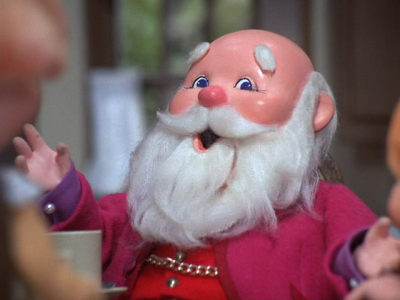
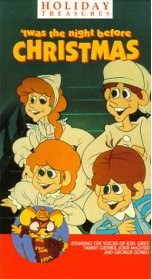
This question is a stock theme in Christmas movies and specials, and I've always been fascinated by the treatment of it. In particular I spent way too much time as a kid contemplating the solutions found in Christmas specials such as The Year without a Santa Claus and that Rankin-Bass cartoon special with the mice of Twas the Night Before Christmas.


In The Year without a Santa Claus, I love the part where Santa Claus -- incognito -- heartfully sings "There's no question in my mind that he does exist!" That has got to be one of my all-time favorite lines anywhere in all of the literary arts just because it's so surreal. It's as if I were reading along in Pride and Prejudice and during one of their garden walks Elizabeth turns to Mr. Darcy and says "Wait a minute... Do we really exist or are we just fictional characters?"

I don't know if all of you have seen that cartoon with the mice as many million times as I have, so since it's less famous, I'll give you a quick run-down: The nerdy poindexter too-smart-for-his-own-britches brainiac mouse writes a letter to the editor of the local paper explaining that Santa Claus doesn't exist, and Santa Claus takes offense and decides he won't be giving any presents to anyone in the whole town. (Nice, huh?) So the others convince poindexter to believe in Santa and to fix the town's special clock that was built to placate Santa with Christmas music.

The mouse cartoon has an interesting musical number that gives an intriguing argument against skepticism. (I'm typing this from memory, so feel free to correct me if I've made any errors):

There's more to the world than meets the eye,
when doubt's in your mind give your heart a try,
let up a little on the wonder why
and give your heart a try.

What would Spring be without the Easter Bunny?
Like a rainbow that doesn't end in money.
And a Valentine would certainly look stupid
without a cupid
so let his arrow in your heart.
That would be a start.

The musical number "I Believe in Santa Claus" (from The Year without a Santa Claus) has a similar theme. The skeptical kid's dad sings about seeing Santa himself as a kid and hearing Santa say to him the following:

"So you're too old for Santa Claus?"
he said with a smile,
"Then you're too old for all the things
that make a life worthwhile.
For what is happiness but dreams,
and do they all come true?
Look at me and tell me, son,
what is real to you."

Like I said, I've spent way too much time trying to figure out what these songs could possibly mean. I think it's very likely I've spent more time contemplating them than the songwriters did before they were recorded. And the more I try to figure them out, the more I feel like I'm Mr. Spock trying to make some sense of these unfathomable humans.

On the one hand, the two songs above seem to take a very negative and dismissive attitude towards people who refuse to let a little magic into their lives. Yet interestingly they seem to be arguing that you should believe your cherished myths even though they're not true. In other words, their argument against the skeptic is not that he's wrong, but rather that by pointing out that the myths are fiction, he's being a big spoil-sport and raining on everyone's parade.

The Polar Express is a more recent movie covering this same question, and one that -- thanks to my kids -- I'm well on my way to having seen and contemplated as much as I have these other two.


The Polar Express also seems to make the point that you should believe for the sake of believing. But it doesn't belabor the point with a musical number like the other two. This one takes an entirely different strategy, one which I find about a hundred times more hilarious. I don't know if they're just following the book or what, but these writers basically seem to have observed the following:

"Hey, if our goal is to convince the skeptical characters to believe in Santa Claus -- and we've set the story in a fantasy universe where Santa Claus really does exist -- why bother persuading the skeptics to overlook the lack of evidence? Why not just show them the evidence?"

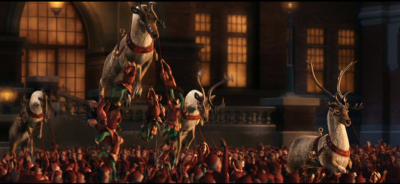
So that's what they do. The doubting kids get a free train ride to the North Pole where they get to meet Santa in person, and see all of his magic in action -- the flying reindeer, stopping time at midnight, fitting billions of presents into a magic bag -- the works!!!


The result? The doubting kids are convinced that, yes, Santa Claus really does exist. I think that's the best solution ever to this problem!!! Hell, that'd be enough to convince me!!! :D

(As long as it was reproducible...)

Personally, I don't think it makes Christmas any less fun to realize that the Santa story is just fiction like many other fun stories we like to tell at Christmas time. That's what it was to me as a kid. I don't have any recollection of ever having thought that Santa Claus was real or of discovering he's not, and I'm certain that's the sort of thing my anecdote-oriented brain would have saved.

Even though my Dad wanted all of us kids to believe Santa was real, as far as I recall none of us ever did. I suspect that my mom may have been secretly slipping us hints that it's really just a fun story. My mom is a bit of a natural skeptic in that she's not shy about her opinion that it's absurd to believe in things like superstitions, astrology, ESP, etc.

You may be protesting right about now "But isn't she a believing Mormon?" It turns out that's a big part of it. The thing is that my mom likes to maintain a wall of separation between "Mormon truth" and other types of supernatural-not-backed-by-evidence beliefs that many people hold. She doesn't like people to notice parallels between the two.

After all, if we notice that the Santa story isn't real -- but we believe it just for the joy of believing -- there's a danger of wondering "Hmm, and what about that other Christmas story...?"